
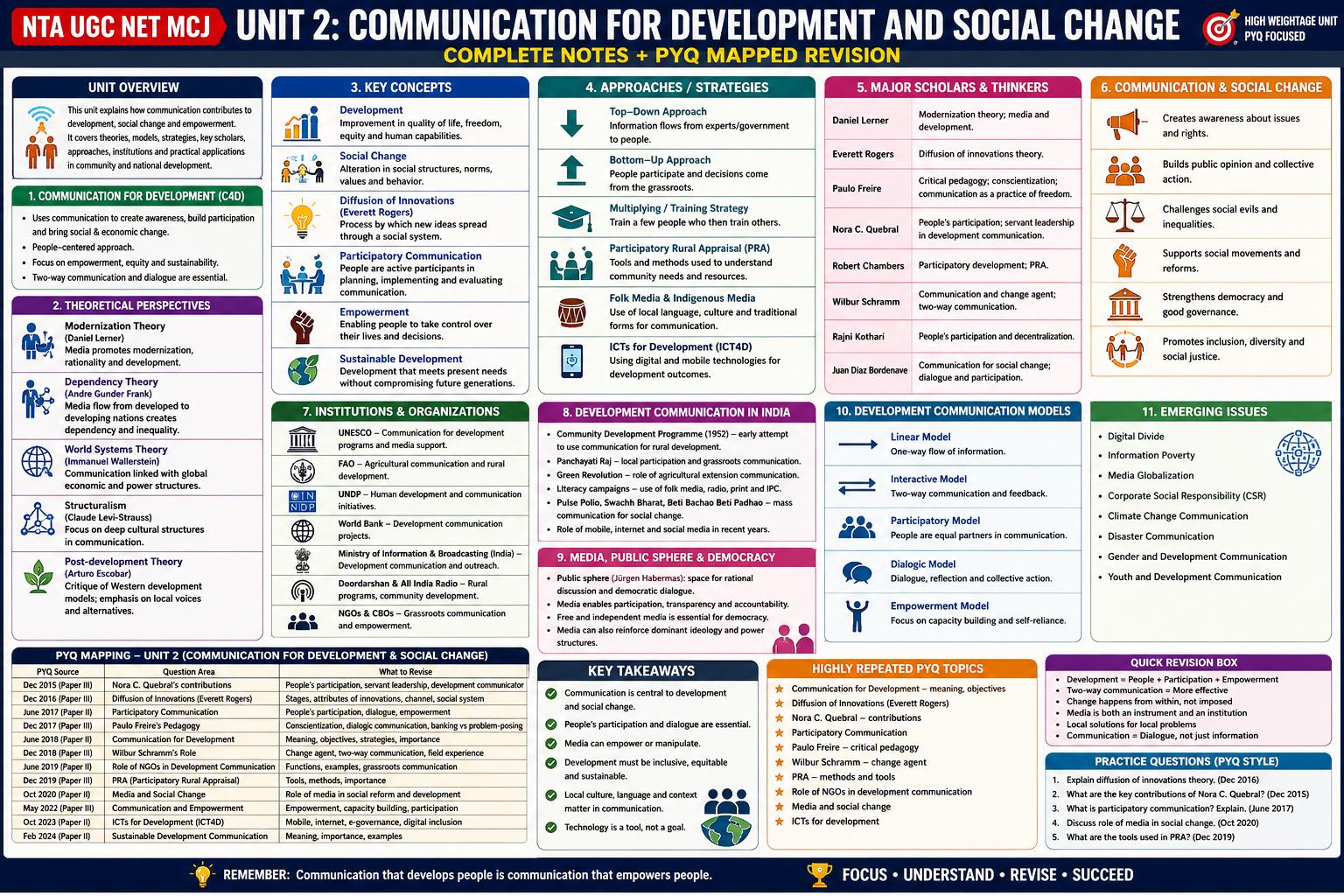
Unit 2 Complete Notes: Communication for Development and Social Change
1. Official Unit 2 Scope at a Glance
| Syllabus Area | What to Prepare |
|---|---|
| Development communication | Concept, definition, role of media and journalism in society. |
| Indian society and audiences | Demographic and sociological impact of communication, media and journalism; media and specific audiences. |
| Development and social change | Meaning of development, social change, post-colonial conceptions and critique of development models. |
| Dominant paradigm | Modernisation, diffusion, top-down development and critiques of dominant models. |
| Corporatisation of development | CSR, non-state actors, NGOs, government campaigns, international agencies and corporate campaigns. |
| Public sphere and global civil society | Global communication system, national communication policies and civil society debates. |
| Indian social reformers | Raja Rammohan Roy, Malaviya, Tilak, Jyotiba Phule, Gandhi, Vinoba Bhave, Ambedkar, Deendayal Upadhyay, Ram Manohar Lohia and others. |
2. Infographic Flow: Development Communication
3. Meaning and Definition of Development Communication
Development communication refers to the planned use of communication processes, media systems and participatory dialogue for social and economic development. It may involve awareness campaigns, health education, agricultural communication, environmental communication, literacy movements, community mobilisation and policy communication.
| Concept | Meaning | Exam Point |
|---|---|---|
| Development communication | Communication used for development and social transformation. | Important for direct definition and scholar-based questions. |
| Development support communication | Communication that supports development projects and programmes. | Linked with planning, campaigns and project communication. |
| Participatory communication | People participate in identifying issues, creating messages and evaluating change. | Repeated PYQ area. |
| Social change | Transformation in social structure, values, behaviour, institutions and relationships. | Frequently linked with development and media role. |
4. Development, Modernisation and Social Change
Development is not only economic growth. It includes education, health, social justice, equality, participation, empowerment, sustainability and human development. Social change refers to transformation in society’s institutions, relationships, practices, ideas and values.
| Term | Meaning |
|---|---|
| Modernisation | Movement from traditional society to modern social, economic and political systems. |
| Social change | Change in social institutions, beliefs, norms and behaviour. |
| Empowerment | Enabling people and communities to control decisions affecting their lives. |
| Sustainable development | Development that balances present needs with long-term social and environmental responsibility. |
| Another development | Alternative approach emphasising justice, participation, sustainability and human-centred development. |
5. Role of Media and Journalism in Society
Media and journalism support development by informing citizens, exposing problems, creating awareness, encouraging debate, giving voice to marginalised groups and monitoring public institutions.
| Role | Development Use |
|---|---|
| Information | Spreads knowledge about policies, schemes, rights and opportunities. |
| Education | Supports literacy, health, agriculture, environment and civic education. |
| Mobilisation | Encourages participation in public campaigns and community action. |
| Watchdog | Questions corruption, injustice and policy failure. |
| Representation | Provides visibility to specific audiences and marginalised groups. |
6. Indian Society, Demography and Specific Audiences
Indian society is multilingual, multicultural, multi-religious, rural-urban, caste-class structured and regionally diverse. Development communication must therefore be audience-specific and culturally sensitive.
| Specific Audience | Communication Need | Useful Media Form |
|---|---|---|
| Rural communities | Agriculture, health, livelihood, governance and welfare schemes. | Radio, folk media, mobile media, community meetings. |
| Women | Health, education, rights, financial inclusion and empowerment. | Community media, SHG communication, radio, mobile campaigns. |
| Youth | Education, employment, civic participation and digital awareness. | Social media, short video, digital platforms. |
| Children | Education, nutrition, health and media literacy. | School media, television, animation, storytelling. |
| Marginalised groups | Rights, access, representation and voice. | Community radio, participatory video, local-language media. |
7. Dominant Paradigm of Development Communication
The dominant paradigm viewed development as modernisation. It emphasised industrialisation, urbanisation, literacy, mass media exposure, economic growth and diffusion of modern values. It was largely top-down and expert-driven.
| Dominant Paradigm Feature | Meaning |
|---|---|
| Top-down communication | Messages flow from experts, governments or institutions to the people. |
| Modernisation focus | Development is linked with modern values, technology and economic growth. |
| Mass media as change agent | Media are seen as tools for spreading modern ideas. |
| Diffusion model | Innovations are spread from sources to adopters through communication channels. |
| Individual receiver focus | Development message is directed toward changing individual attitudes and behaviour. |
8. Important Modernisation and Development Scholars
| Scholar | Associated Idea | PYQ Focus |
|---|---|---|
| Daniel Lerner | Modernisation, empathy, media exposure and transition from traditional to modern society. | Frequently asked in development communication theory questions. |
| Wilbur Schramm | Mass media and national development. | Asked in connection with development and media images. |
| Everett M. Rogers | Diffusion of innovations. | Stages and adopter categories are repeatedly asked. |
| Lucian Pye | Political communication and development. | Appears as an option in development-related questions. |
| Jan Servaes | Multiplicity / participatory development communication perspective. | Asked in multiplicity model questions. |
| Paulo Freire | Dialogic and participatory communication; conscientisation. | Important for participatory and critical development communication. |
9. Critique of Dominant Models
Dominant models were criticised because they were too linear, Western-centred, top-down and economic-growth oriented. They often ignored local culture, power relations, inequality, participation and indigenous knowledge.
| Criticism | Explanation |
|---|---|
| Top-down approach | People are treated as receivers rather than active participants. |
| Western bias | Western modernity is treated as the universal model of progress. |
| Neglect of culture | Local knowledge, traditions and identities are ignored. |
| Economic reductionism | Development is reduced to growth and infrastructure. |
| Limited participation | Communities are not involved in decision-making. |
10. Diffusion of Innovations
Diffusion of innovations theory explains how new ideas, practices and technologies spread through a social system over time. It is associated with Everett M. Rogers.
| Adopter Category | Meaning |
|---|---|
| Innovators | First to adopt new ideas. |
| Early adopters | Influential people who adopt early. |
| Early majority | Adopt after early adopters but before the average person. |
| Late majority | Adopt after most people have accepted the innovation. |
| Laggards | Last and most resistant adopters. |
11. Participatory Communication
Participatory communication treats people as active participants in the development process. It encourages dialogue, local control, community media, collective decision-making and grassroots empowerment.
| Participatory Feature | Meaning |
|---|---|
| Dialogue | Two-way communication and shared meaning-making. |
| Community voice | People express their needs, problems and knowledge. |
| Local content | Messages are culturally relevant and locally created. |
| Empowerment | Communities gain confidence and control over decisions. |
| Horizontal communication | Communication flows among equals rather than only from authority to people. |
12. Paulo Freire, Dialogue and Conscientisation
Paulo Freire’s approach emphasises dialogue, critical consciousness and liberation from oppressive structures. In development communication, Freire is important because he rejected one-way “banking” education and supported dialogue-based learning and participation.
13. Communitarian Strategy of Development
The communitarian approach emphasises community participation, collective decision-making, local culture and horizontal communication. It is different from top-down development because it values community voices.
14. Development Communication Approaches
| Approach | Main Idea | Keyword |
|---|---|---|
| Modernisation approach | Development through modern values, technology, literacy and mass media. | Top-down |
| Diffusion approach | Spread of innovations through communication channels. | Rogers |
| Dependency critique | Questions unequal global structures and underdevelopment. | Power |
| Participatory approach | Community participation and dialogue. | Freire |
| Multiplicity approach | Multiple paths to development; rejects one universal model. | Servaes |
| Social marketing | Uses marketing methods for social causes and behaviour change. | Campaign |
| Entertainment-education | Uses entertainment formats to communicate educational/development messages. | Edutainment |
15. Corporate Social Responsibility and Non-state Actors
The syllabus includes corporatisation of development, CSR, non-state actors, NGOs, Government of India, international agencies and corporate campaigns. These actors use communication for awareness, advocacy, reputation, social responsibility and development intervention.
| Actor | Communication Role |
|---|---|
| Government | Public information campaigns, health awareness, welfare schemes, disaster communication. |
| NGOs | Community mobilisation, advocacy, awareness, grassroots campaigns. |
| International agencies | Global development campaigns, health, education, environment and child welfare communication. |
| Corporates | CSR campaigns, social responsibility communication and corporate development partnerships. |
| Civil society | Public debate, social movements, rights communication and collective action. |
16. Public Sphere and Global Civil Society
The public sphere refers to a space where citizens discuss public issues and form public opinion. Global civil society refers to networks of citizens, NGOs, movements and organisations that participate in global debates beyond national boundaries.
| Concept | Meaning |
|---|---|
| Public sphere | Space for public debate, discussion and opinion formation. |
| Civil society | Non-state associations and groups that participate in public life. |
| Global civil society | Transnational networks and movements working on global concerns. |
| Global communication system | Communication networks that connect people, nations, institutions and media systems globally. |
| National communication policy | Policy framework guiding media, communication infrastructure and public communication goals. |
17. Media, Campaigns and Social Change
Development campaigns use media to influence awareness, attitude and behaviour. They may address literacy, family welfare, health, sanitation, agriculture, environment, vaccination, disaster preparedness, gender equality and voting awareness.
18. Indian Social Reformers and Communication for Social Change
| Influencer | Social Change Area | Communication Relevance |
|---|---|---|
| Raja Rammohan Roy | Social reform, anti-Sati, education and press activity. | Used journalism and public argument for reform. |
| Pandit Madan Mohan Malaviya | Education, nationalism and public life. | Linked with education and national consciousness. |
| Bal Gangadhar Tilak | Nationalist mobilisation. | Used press and public communication for political awakening. |
| Mahatma Jyotiba Phule | Anti-caste reform, women’s education and social equality. | Communication for equality and social justice. |
| Mahatma Gandhi | Freedom struggle, constructive programmes and social reform. | Used newspapers, symbols, speeches, campaigns and interpersonal communication. |
| Acharya Vinoba Bhave | Bhoodan movement and rural reform. | Used persuasion, dialogue and moral communication. |
| Dr B. R. Ambedkar | Social justice, constitutional rights and anti-caste movements. | Used writing, speeches, journalism and public debate. |
| Deendayal Upadhyay | Integral humanism and social-political thought. | Linked with development thinking and public ideology. |
| Dr Ram Manohar Lohia | Socialism, equality and political mobilisation. | Used public communication for democratic and social justice concerns. |
19. PYQ Mapping Table
| PYQ Source | Question Area | What to Revise |
|---|---|---|
| December 2015 Paper III | Definition of development communication | Nora C. Quebral and development communication in the 1970s. |
| December 2014 Paper III | Development communication definition | Franklin / F. Rosario-Braid definition area. |
| June 2012 Paper III | Daniel Lerner and development | Media exposure energising empathy for development. |
| September 2016 Paper III | Revolution of rising expectations | Daniel Lerner and development communication. |
| June 2012 Paper III | Multiplicity model | Jan Servaes and multiplicity approach. |
| December 2010 Paper II | Dominant paradigm | Dominant paradigm as blueprint for quick development; top-down approach. |
| July 2018 Paper II | Diffusion model critique | Linear transmission to atomised individuals. |
| June 2008 Paper II | Diffusion of innovations | Correct sequence of Rogers’ stages. |
| June 2013 Paper III | Diffusion of innovations | Knowledge, persuasion, decision and confirmation sequence. |
| December 2015 Paper III | Adopter category | Non-adopters / laggards in diffusion of innovations. |
| December 2012 Paper III | Rogers and diffusion | Cosmopoliteness and diffusion of innovation. |
| December 2009 Paper II | Participatory communication | People’s participation from idea to reception of message. |
| June 2013 Paper III | Community empowerment | Innovative, imaginative and participatory communication for grassroots development. |
| September 2016 Paper III | Communitarian strategy | Horizontal communication. |
| September 2016 Paper III | Paulo Freire | Dialogical communication and participatory approach. |
| July 2018 Paper II | Social dialogue | Mikhail Bakhtin and social dialogue as essential for development. |
| July 2018 Paper II | Communication for sustainable development | Transformative learning and participatory communication. |
| January 2017 Paper III | Another development | Sustainable development and accountable communication. |
20. Frequently Repeated PYQ Areas
21. Quick Revision Sheet
| Concept | One-line Revision |
|---|---|
| Development communication | Communication for planned development and social change. |
| Nora C. Quebral | Important name associated with development communication definition. |
| Dominant paradigm | Top-down modernisation model of development. |
| Daniel Lerner | Media exposure, empathy and modernisation. |
| Rogers | Diffusion of innovations and adopter categories. |
| Freire | Dialogic and participatory communication. |
| Communitarian approach | Horizontal communication and community participation. |
| CSR | Corporate role in development and social responsibility campaigns. |
| Public sphere | Space for public debate and opinion formation. |
| Global civil society | Transnational citizen and NGO networks involved in public issues. |
22. Practice Questions with PYQ Angle
Answer: Nora C. Quebral.
PYQ Angle: December 2015 Paper III.
Answer: Empathy.
PYQ Angle: June 2012 Paper III.
Answer: Diffusion of innovations.
PYQ Angle: June 2008 Paper II and June 2013 Paper III.
Answer: Horizontal communication.
PYQ Angle: September 2016 Paper III.
Answer: Participatory communication.
PYQ Angle: December 2009 Paper II.
Answer: Social dialogue.
PYQ Angle: July 2018 Paper II.
Answer: It is top-down, linear and often ignores participation, local culture and structural inequality.
PYQ Angle: December 2010 Paper II and July 2018 Paper II.
23. Final Exam Tip
For Unit 2, revise through four tables: scholar-concept, development approaches, diffusion stages/adopter categories, and PYQ mapping. Questions usually come as direct scholar identification, assertion-reason, chronology, matching and concept application.