
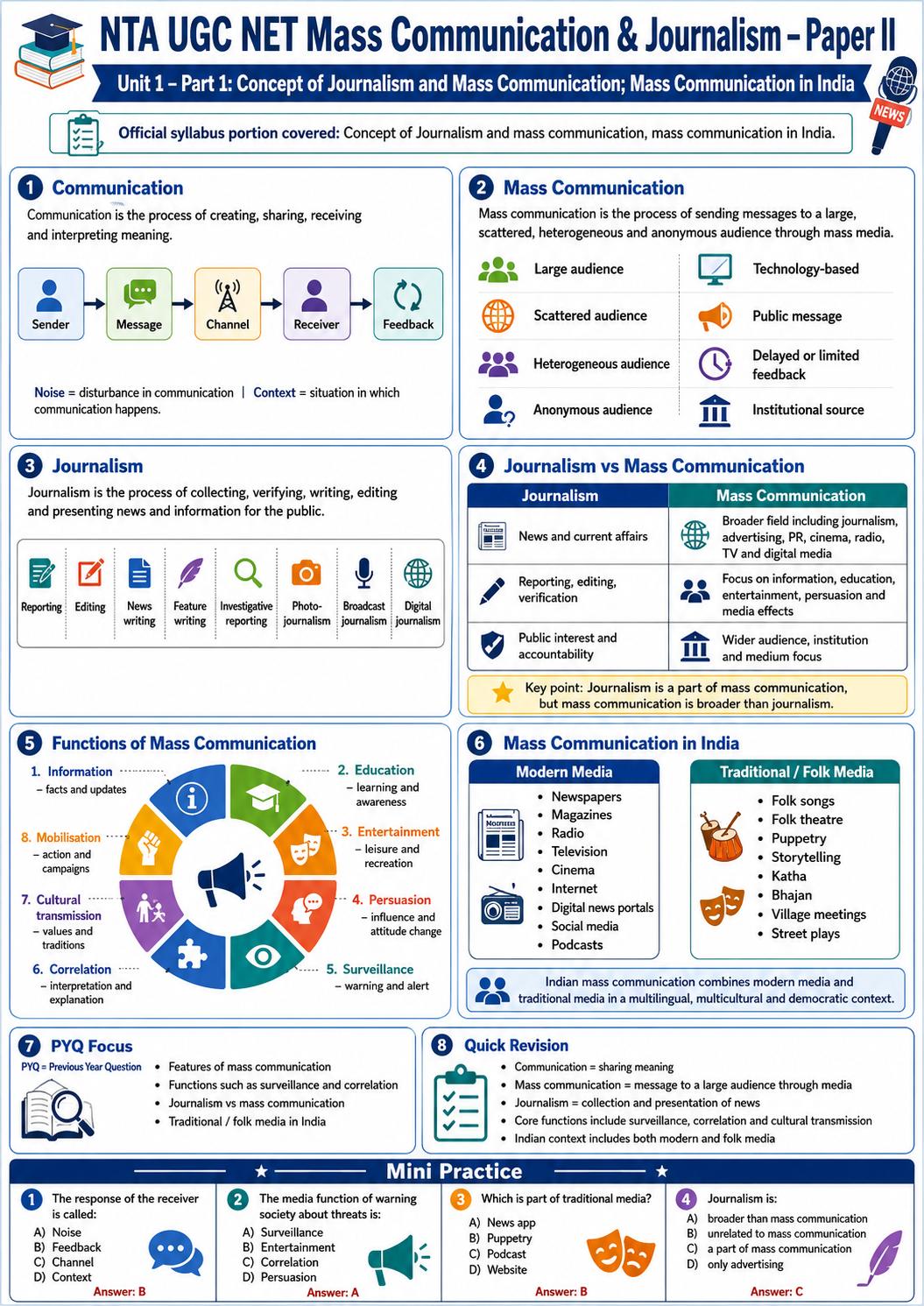
Part 1: Concept of Journalism and Mass Communication; Mass Communication in India
1. Communication
Communication is the process of creating, sharing, receiving and interpreting meaning. It is not only the transfer of information from one person to another. It also involves understanding, response, context and possible disturbance.
| Element | Meaning |
|---|---|
| Sender | The source or originator of the message. |
| Message | The content, idea, information or feeling being shared. |
| Channel | The medium through which the message travels, such as speech, print, radio, television or digital media. |
| Receiver | The person or audience that receives and interprets the message. |
| Feedback | The response given by the receiver to the sender. |
| Noise | Any disturbance that affects the clarity of communication. |
| Context | The social, cultural, political, physical or psychological setting in which communication happens. |
2. Mass Communication
Mass communication is the process of transmitting messages to a large, scattered, heterogeneous and anonymous audience through mass media. The sender is usually an institution, such as a newspaper, television channel, production house, news portal or digital platform.
| Feature | Meaning for exam preparation |
|---|---|
| Large audience | The message reaches many people at the same time or across a wide area. |
| Scattered audience | Receivers are geographically dispersed and not located in one place. |
| Heterogeneous audience | The audience differs in class, age, education, region, language, gender and culture. |
| Anonymous audience | The sender generally does not know individual receivers personally. |
| Technology-based | It depends on media technologies such as print, radio, television, cinema, web and mobile platforms. |
| Public message | The message is open to a broad public, not merely to a private individual. |
| Delayed or limited feedback | Feedback exists but is slower or weaker than in face-to-face communication. |
| Institutional source | Messages are often produced by organised institutions and professionals. |
Examples of mass media include newspapers, magazines, radio, television, cinema, websites, social media, podcasts and news apps.
3. Journalism
Journalism is the process of collecting, verifying, writing, editing and presenting news and information for the public through different media. It is a profession as well as a public service. Accuracy, fairness, timeliness, objectivity and public interest are core values of journalism.
4. Journalism and Mass Communication: Difference
| Journalism | Mass Communication |
|---|---|
| Mainly concerned with news, current affairs and public-interest information. | A broader field that includes journalism, advertising, public relations, cinema, radio, television and digital media. |
| Focuses on reporting, editing, verification and presentation of news. | Focuses on information, education, entertainment, persuasion, audience, technology and media effects. |
| Truth, verification and accountability are central. | Reach, medium, institution, social role and effects are also central. |
5. Functions of Mass Communication
Questions from this area are common. Learn both the function name and the clue that identifies it.
| Function | Meaning | Common clue words in questions |
|---|---|---|
| Information | Providing facts and updates about events, issues, policies and developments. | Facts, updates, public information |
| Education | Helping people learn through awareness messages, explanatory content and educational programmes. | Learning, awareness, knowledge |
| Entertainment | Providing leisure through films, music, serials, sports and cultural content. | Leisure, amusement, recreation |
| Persuasion | Influencing attitudes and behaviour through campaigns, advertisements, editorials and advocacy. | Influence, attitude change, behaviour |
| Surveillance | Watching the environment and warning people about important events, threats, disasters or changes. | Warning, alert, watchdog |
| Correlation | Interpreting events and connecting facts so that people understand their meaning. | Interpretation, analysis, explanation |
| Cultural transmission | Passing culture, values, language and traditions from one generation to another. | Values, traditions, continuity |
| Mobilisation | Motivating people to take collective action, such as voting, health campaigns or social action. | Campaign, voting, collective action |
6. Mass Communication in India
Indian mass communication combines both modern media and traditional or folk media. This is important because India is multilingual, multicultural, democratic, and marked by both rural and urban communication contexts.
Modern media in India
- Newspapers
- Magazines
- Radio
- Television
- Cinema
- Internet and digital news portals
- Social media, podcasts and mobile news apps
Traditional / folk media in India
- Folk songs
- Folk theatre
- Puppetry
- Storytelling
- Katha and bhajan
- Village meetings
- Street plays and regional oral traditions
Why traditional media matter in India
- They are culturally rooted and easy for local communities to identify with.
- They can communicate with people who have limited literacy or limited access to modern technologies.
- They are useful in development communication, awareness campaigns and rural outreach.
- They preserve regional identity and oral traditions.
| Example | What to remember |
|---|---|
| Yakshagana, Tamasha, Bhaona, Burrakatha, Therukoothu and puppetry | Examples of folk or traditional media forms. Some questions may link them with states or regions. |
| Village meetings, bhajan, katha, storytelling | Important for rural communication and cultural transmission. |
| Radio with folk forms in campaigns | Useful for awareness and development communication in the Indian context. |
7. Previous Year Question Linkage
| Concept area | Type of earlier question noticed | Year references |
|---|---|---|
| Feedback | Role of feedback in communication. | 2010, 2012, 2013, 2014 |
| Surveillance | Function-based identification question. | 2010, 2012, 2013, 2016 |
| Correlation | Function-based identification / interpretation role of media. | 2009, 2010, 2013, 2014, 2015 |
| Mobilisation / Mobilization | Function-based questions and concept-linked usage. | 2006, 2010, 2013 |
| Traditional / folk media | Examples, identification and state-link questions. | 2006, 2008, 2009, 2011, 2012, 2013, 2015, 2017, 2018 |
8. Practice Questions
1. Which communication element refers to the response given by the receiver?
A. Message
B. Feedback
C. Noise
D. Context
Answer: B. Feedback
Related years: 2010, 2012, 2013, 20142. Mass communication mainly differs from interpersonal communication because it generally addresses:
A. A single familiar receiver
B. A closed family group
C. A large, scattered and heterogeneous audience
D. Only a literate audience
Answer: C. A large, scattered and heterogeneous audience
Related years: 2006, 2007, 2009, 2010, 2012, 20133. The media function that warns society about threats and events is called:
A. Entertainment
B. Surveillance
C. Correlation
D. Cultural transmission
Answer: B. Surveillance
Related years: 2010, 2012, 2013, 20164. The media function that interprets events and helps the public understand them is:
A. Correlation
B. Surveillance
C. Mobilisation
D. Diversion
Answer: A. Correlation
Related years: 2009, 2010, 2013, 2014, 20155. Passing values, traditions and culture from one generation to another is known as:
A. Cultural transmission
B. Persuasion
C. Institutionalisation
D. Feedback
Answer: A. Cultural transmission
Related year: 20166. Journalism is best understood as:
A. Only advertisement writing
B. The process of collecting, verifying and presenting news and information
C. Any public speech
D. A private mode of communication
Answer: B. The process of collecting, verifying and presenting news and information
7. Which statement is correct?
A. Journalism is broader than mass communication.
B. Mass communication is a part of journalism.
C. Journalism is a part of mass communication.
D. Journalism and mass communication are unrelated.
Answer: C. Journalism is a part of mass communication
8. Which of the following belongs to traditional / folk media?
A. News portal
B. Community podcast
C. Puppetry
D. News app
Answer: C. Puppetry
Related years: 2006, 2008, 2009, 2011, 2012, 2013, 2015, 20189. A campaign that motivates people to vote is mainly performing which function of mass communication?
A. Correlation
B. Mobilisation
C. Entertainment
D. Noise reduction
Answer: B. Mobilisation
Related years: 2006, 2010, 201310. Which feature of mass communication means the sender usually does not personally know the receivers?
A. Institutional source
B. Public nature
C. Anonymous audience
D. Cultural continuity
Answer: C. Anonymous audience
9. Quick Revision
- Communication = creating and sharing meaning.
- Mass communication = messages sent through mass media to a large, scattered, heterogeneous and anonymous audience.
- Journalism = collecting, verifying, writing, editing and presenting news and information.
- Journalism is a part of mass communication.
- Core functions = information, education, entertainment, persuasion, surveillance, correlation, cultural transmission and mobilisation.
- Mass communication in India includes both modern media and traditional / folk media.
- Surveillance = warning; correlation = interpretation; cultural transmission = values; mobilisation = action.